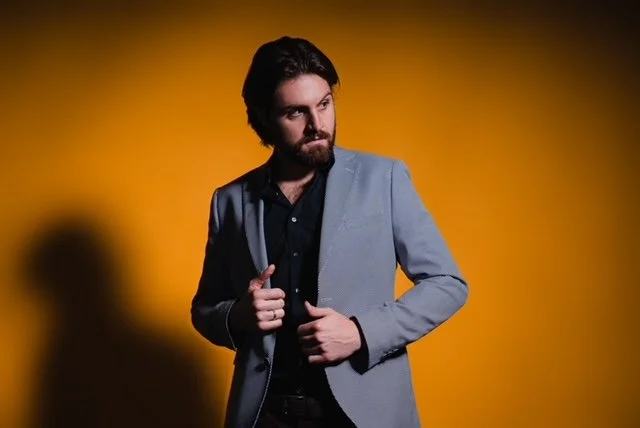
Jan Lisiecki Returns to Mozart, and Finds Music Two Centuries Ahead of Its Time
The Canadian pianist's new Deutsche Grammophon album pairs Mozart's Ninth and Twenty-Second Piano Concertos with conductor Manfred Honeck and the Bamberger Symphoniker — his first Mozart concertos on record in fourteen years, and a return that changed what he hears in the composer.
At a glance
Who: Jan Lisiecki — pianist; Canadian, born 1995 in Calgary
Training: The Glenn Gould School of The Royal Conservatory of Music, Toronto (began piano at five; orchestral debut at nine)
Label: Deutsche Grammophon (exclusive artist since age fifteen)
Known for: Chopin and Mozart concerto recordings; roughly 100 concerts a year on the world's major stages
New release:Mozart: Piano Concertos Nos. 9 & 22 (K. 271 “Jeunehomme” and K. 482, both in E-flat Major), with Manfred Honeck and the Bamberger Symphoniker — Deutsche Grammophon, released April 28, 2026
Key collaborators: Manfred Honeck; earlier, Claudio Abbado, Antonio Pappano, Yannick Nézet-Séguin
Recognition: Gramophone Young Artist Award (its youngest recipient) and the Leonard Bernstein Award, both at eighteen; JUNO Award; ECHO Klassik; Diapason d'Or; UNICEF Ambassador to Canada
Jan Lisiecki has been recording since he was a teenager. He signed to Deutsche Grammophon at fifteen, and by his late teens had won the Gramophone Young Artist Award — its youngest-ever recipient — and the Leonard Bernstein Award. Now thirty-one, he has returned to the composer who has bracketed his catalogue from the start: Mozart. His new album pairs the Piano Concertos Nos. 9 and 22, recorded with the Austrian conductor Manfred Honeck and the Bamberger Symphoniker for Deutsche Grammophon. It is his first Mozart concerto recording in fourteen years, and the distance is the point. What he hears in Mozart now, he says, is not easier with age but harder — and, listening closer, stranger and more modern than the composer's sunlit reputation admits.
Returning to Mozart, fourteen years on
Lisiecki's recorded relationship with Mozart began early: in 2012, still a teenager, he set down the Piano Concertos Nos. 20 and 21. Coming back to the composer more than a decade later, he found the ground had shifted under him. “Mozart is easiest to play when you have some youthful spontaneity to add to it,” he says, “and certainly, fourteen years after the initial recording, some of that innocence is gone. So finding that pureness and that joy and that emotion is something that you have to continue to find in Mozart.” It is the paradox every maturing musician meets: the technique deepens, and the ease it once traveled with has to be pursued on purpose. Mozart, he suggests, exposes the loss more than most composers do. What remains is a search for “that elegance and… the purity of his music” — the qualities that can't be forced, only found.
The conductor he had been waiting for
If the album has an origin story, it is a conductor. Lisiecki first worked with Manfred Honeck in December 2019, performing Mozart's Piano Concerto No. 21 with the Chicago Symphony, and what he encountered was not quite what a famous name had led him to expect. “I expected him to be wonderful,” he says. “But what I didn't expect was — not only did he bring that Viennese tradition and knowledge and experience of working with Mozart all his life, also from the perspective of being an orchestra musician, but he was also able to communicate that.” The distinction matters to him: plenty of conductors carry a tradition; fewer can transmit it to an entire ensemble. That experience is what eventually sent the two of them to Bamberg. “It was a dream come true,” Lisiecki says — the sessions left him “the most inspired I'd been in Mozart for a long time.”
Why Mozart chose E-flat major — and handed the clarinets the lead
Both concertos on the album are in E-flat Major, and Lisiecki hears the key itself as a temperament. Asked for the emotional signature of Mozart's music, he doesn't complicate it: “The two words that come to mind for me are beauty and joy.” In E-flat, he says, “we don't find very much suffering, very much pain. It's this exuberance, it's this energy, it's this drive, it's elegance.” The Twenty-Second Concerto, K. 482, also carries a historical first that clearly delights him: it is the earliest of Mozart's piano concertos to give the clarinets a leading role, and the choice is audible from the opening bar. “There isn't even an oboe to compete with,” he explains, “so from the very beginning, it's either the clarinetist or the concertmaster that tunes — unlike what happens in 99% of all music, where it's the oboe giving the A.” For Lisiecki it is a quiet revolution: an instrument Mozart “not only just incorporated, but really gave the leading role.”
The cadenza Mozart wrote himself
The Ninth Concerto, K. 271 — nicknamed the “Jeunehomme” — hands Lisiecki a rarer gift. In most Mozart concertos the cadenza is the soloist's problem to solve, written or improvised, because the composer's own rarely survive. The Ninth is the exception, and in an unlikely place. “We don't have cadenzas in second movements. It's not really a place for a cadenza,” Lisiecki says. “But here Mozart not only incorporates one, but incorporates quite a long one that he wrote himself — and for each of these movements, we have a choice of three cadenzas.” Where other concertos leave the soloist guessing at the composer's intentions, this one removes the guesswork. “In the Ninth Concerto, we don't have to do that,” he says, “because we have Mozart's original. We have the best we can find.”
A passage that sounds two centuries too early
It is inside that surviving cadenza that Lisiecki locates the album's most startling moment — and the reason he keeps calling Mozart forward-thinking. He describes a single gesture: the right hand playing a trill while the left runs a chromatic scale, the two lines moving in opposite directions. “That dissonance, if you take it out of context, if you just play that to an unsuspecting audience member today, they wouldn't be surprised to hear that it came from a 20th-century piece of music — because that's how forward-thinking it was.” The point isn't novelty for its own sake. It's a window onto how much of Mozart still hasn't been fully reckoned with. “Mozart was a true genius,” he says, “and we only have the privilege of scraping the surface of what he left.”
Why record Mozart again in 2026
Which raises the obvious question about a catalogue already crowded with landmark Mozart: why add another. Lisiecki's answer is unusually modest for a headline artist. “My role isn't to present the history of the music,” he says, “but it is to give a little bit of my own perspective.” He is not trying to displace the recordings he grew up with — he says plainly that they “withstand the test of time, and I will go back to them myself.” The aim is smaller and more durable: to keep the music present. “I feel very privileged that despite the challenges we face today, despite the changes that the industry has had in the past years, that we still can record — and that I can keep this music alive for today, for 2026.” He wrote the album's liner notes himself, and is quick to disclaim the role of scholar: “It's not an essay, and I'm no historian.” What he offers instead is a performer's reading — “not to replace them, but simply give a new perspective, a current perspective.”
What stays with him
For all the talk of tradition, what comes through is a musician still surprised by a composer he has played his whole life — and content to let that be the reward. Mozart, in Lisiecki's telling, is not a monument to be maintained but a genius we have only begun to read. “We only have the privilege of scraping the surface of what he left,” he says. Fourteen years on from his first Mozart, he is still scraping — and still finding.
Jan Lisiecki's Mozart: Piano Concertos Nos. 9 & 22 is out now on Deutsche Grammophon. Watch the full Classical Post conversation on YouTube.
Prefer to listen? Stream the audio on Apple Podcasts, Spotify, or wherever you listen.
Frequently asked questions
What is on Jan Lisiecki's new Mozart album? Mozart: Piano Concertos Nos. 9 & 22 pairs the Ninth (K. 271, “Jeunehomme”) and the Twenty-Second (K. 482), both in E-flat Major, recorded with conductor Manfred Honeck and the Bamberger Symphoniker for Deutsche Grammophon (2026).
Why did Jan Lisiecki return to Mozart after fourteen years? His first Mozart concerto recording came in 2012, as a teenager (Nos. 20 & 21). Returning to the composer, he says the “youthful spontaneity” that once made Mozart easy is gone, so its purity and elegance now have to be searched for on purpose.
Who conducted Jan Lisiecki's Mozart Concertos Nos. 9 & 22? Manfred Honeck, leading the Bamberger Symphoniker. Lisiecki first worked with him in December 2019, performing Mozart's Piano Concerto No. 21 with the Chicago Symphony.